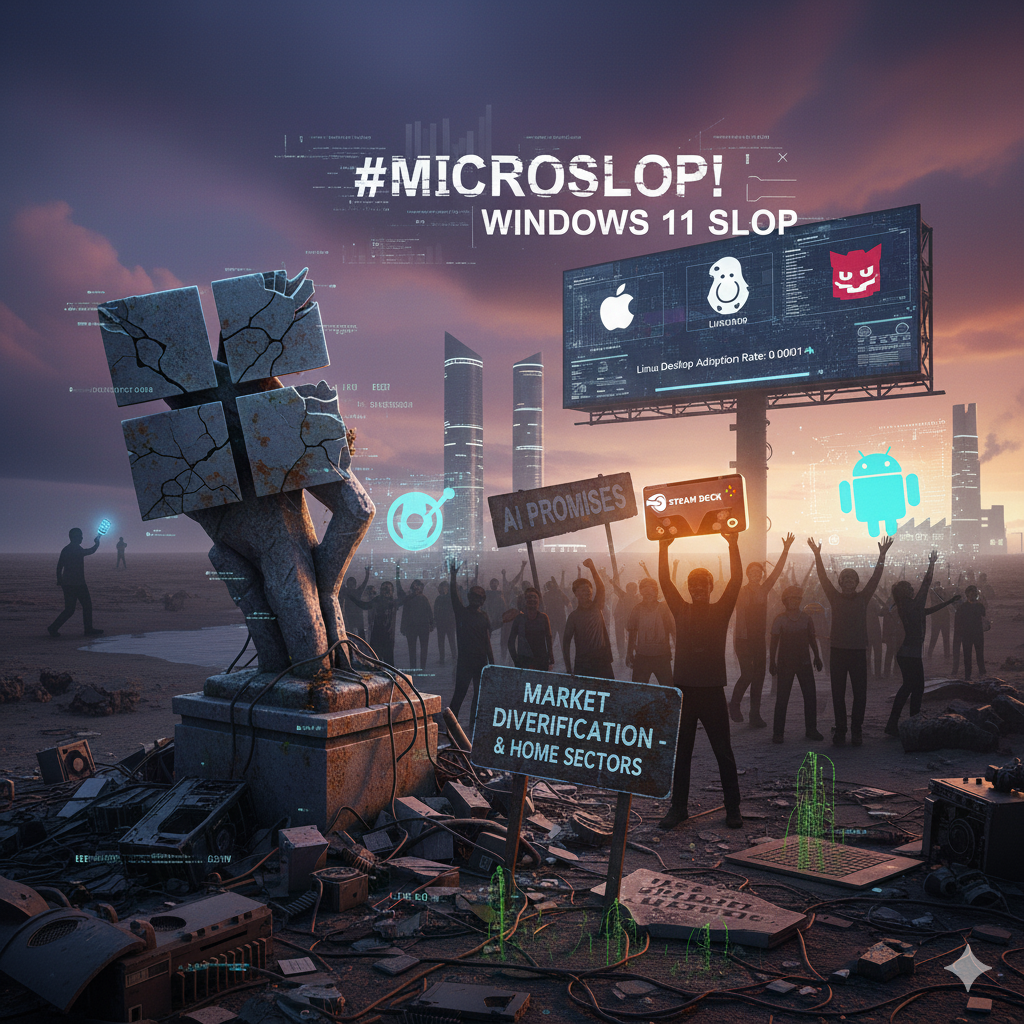
¡ #microslop !, grita la red. ¿Pero ese desastre relativo está llevando a la adopción en masa de Linux desktop como opción preferente, tal y como proclaman los voceros del pingüino? En nuestra opinión, no.
Asistimos a una diversificación del mercado debida a estrategias de negocio exitosas de determinadas corporaciones multinacionales, como es el caso de Valve o Google. Las Steam deck, Android y los Chromebook han hecho más por la adopción generalizada de Linux que cualquier canal o usuario adanista o antisistema pro-«GNU/Linux, Arch by the way». Es decir, lo que se está leyendo, viendo y escuchando estas últimas semanas no supone el inicio del «Año del Linux Desktop», ni nada parecido. Sólo obedece a las tendencias coyunturales del mercado de servicios digitales. Un mercado que, gracias a los dioses, va diversificándose en los sectores de hogar y gaming. Probablemente también el sector público. No me queda tan claro que así esté sucediendo en el caso B2B.
Efectivamente, el usuario promedio que dispone de un PC considerado «obsoleto» por Microsoft para la adopción de Windows 11, o uno que no guste de la nueva iteración de los de Redmond y que se decante en consecuencia por seguir usando su hardware ignorando toda recomendación de buen opsec, o bien por los de la manzana mordida o por Bazzite o Linux Mint, está cumpliendo con sus derechos de consumidor, forzando los monolopolios a convertirse en oligopolios o, ¿por qué no?, en sistemas democráticos liberales 😉
Linux en escritorio, hogar, gaming competitivo u oficina no será capaz de perseverar únicamente con una labor de «divulgación» pro-hacker comunistoide. Deberá hacerlo a través de las armas ofrecidas por un mercado liberal competitivo. Confiemos en que más empresas, corporaciones y organizaciones se decanten por macOS, Linux, ChromeOS o FreeBSD para ser competitivas, productivas o divertidas. Ello conllevaría una muy necesaria apertura del mercado.
Un mercado que no puede y no debería estar sometido a los vaivenes o procesos chapuceros o interesados de una sola empresa multinacional.
«#Microslop!» the web screams. But is this relative disaster leading to a mass adoption of Linux desktop as the preferred choice, as the Penguin’s spokesmen proclaim? In our view, no.
We are witnessing a market diversification driven by the successful business strategies of specific multinational corporations, such as Valve or Google. The Steam Deck, Android, and Chromebooks have done more for the widespread adoption of Linux than any «adamist» or anti-establishment user shouting «GNU/Linux, Arch by the way.» That is to say: what we are reading, seeing, and hearing these past few weeks does not mark the beginning of the «Year of the Linux Desktop,» nor anything like it. It merely obeys the cyclical trends of the digital services market—a market that, thank the gods, is diversifying in the home and gaming sectors. Probably in the public sector as well. It is less clear to me that this is happening in the B2B sphere.
Indeed, the average user—the one whose PC is deemed «obsolete» by Microsoft for Windows 11 adoption, or the one who simply dislikes Redmond’s latest iteration and chooses to keep using their hardware (ignoring all good OpSec recommendations), or perhaps defects to the Bitten Apple, Bazzite, or Linux Mint—is simply exercising their consumer rights. They are forcing monopolies to become oligopolies or, why not, liberal democratic systems. 😉
Linux on the desktop—whether for home, competitive gaming, or the office—will not be able to persevere solely through the «outreach» of pro-hacker, commie-leaning activists. It must do so through the weapons offered by a competitive liberal market. Let us hope that more companies, corporations, and organizations opt for macOS, Linux, ChromeOS, or FreeBSD to remain competitive, productive, or entertaining. This would bring about a much-needed opening of the market.
A market that cannot, and should not, be subjected to the whims or the botched, self-serving processes of a single multinational corporation.
Deja una respuesta