
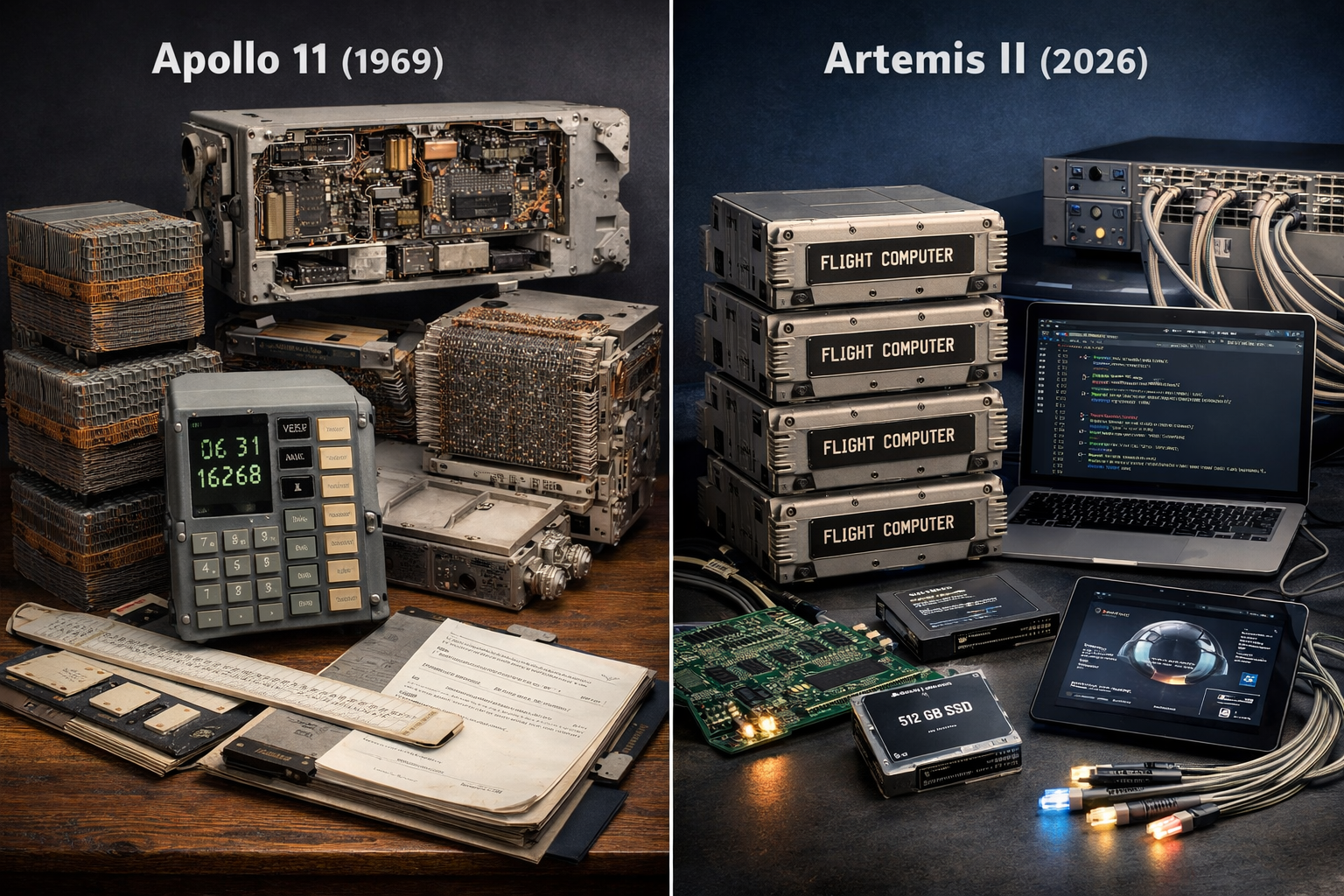
When humanity first set foot on the Moon in 1969, the achievement was not just a triumph of engineering—it was a triumph of constraint.
The computers that guided Apollo 11 had less processing power than a modern car key fob. Yet they were reliable, deterministic, and—most importantly—understood completely by the humans who built and operated them.
Today, as we prepare for Artemis II, the story is no longer about overcoming limitations. It is about managing complexity.
🧵 1. From Handcrafted Logic to Resilient Silicon
In the Apollo era, software was not abstract—it was physical. Programs were woven into memory by hand, encoding logic directly into hardware. This meant near-perfect reliability, but zero flexibility.
Modern systems replace that craftsmanship with radiation-hardened processors designed to survive extreme cosmic conditions. These chips are slower than consumer-grade hardware by design—but vastly more resilient.
👉 The shift is profound:
We have moved from immutability and certainty to adaptability and fault tolerance.
💬 2. From “Verbs and Nouns” to Autonomous Systems
Apollo astronauts interacted with their spacecraft through a structured, almost ritualistic language: commands broken into verbs (actions) and nouns (targets). Every instruction was deliberate. Every outcome predictable.
Today’s spacecraft operate on millions of lines of code, written in high-level languages and running on robust operating systems.
This enables something entirely new:
- Autonomous fault detection
- Self-recovery systems
- Real-time decision support
👉 The interface has shifted from command execution to collaborative intelligence.
🧠 3. Redundancy as Philosophy, Not Feature
Apollo relied on a single primary computer. If it failed, astronauts became the backup system.
Modern spacecraft invert this relationship.
Multiple computers run in parallel, constantly cross-checking each other. If one deviates, it is ignored automatically. The system assumes failure—and is built to survive it.
👉 This is not just engineering. It is a philosophical shift toward distributed trust and systemic resilience.
📊 4. The Exponential Gap
Let’s contextualize the leap:
- Processing power: ~200× increase
- Memory: tens of thousands of times greater
- Storage: thousands of times larger
- Codebase: an order of magnitude more complex
- Communication: from analog signals to high-bandwidth digital networks
But raw numbers don’t tell the full story.
👉 The real leap is not quantitative—it is architectural.
We are no longer building tools.
We are building systems that manage themselves.
📡 5. From Signal to Presence
Apollo’s communication with Earth was fragile, delayed, and limited. Grainy images carried enormous meaning because they were rare.
Artemis-era missions aim for continuous, high-fidelity communication—transforming space exploration into a near real-time shared experience.
👉 The evolution is clear:
From transmission → to immersion.
🤖 6. The Next Frontier: AI in Deep Space
And yet, the most important shift is still ahead.
As missions extend farther—from the Moon to Mars and beyond—communication delays will make real-time control from Earth impossible.
This is where AI becomes essential.
Future spacecraft will need to:
- Diagnose and repair themselves without human input
- Optimize trajectories dynamically
- Assist crews with decision-making under uncertainty
- Act as autonomous partners, not just tools
👉 In deep space, intelligence will no longer be ground-based—it will travel with the mission.
🧭 The Takeaway
Apollo proved that humans could reach the Moon with limited technology and extraordinary discipline.
Artemis represents something different:
A transition from human-controlled systems
to systems that collaborate with humans.
This is not just an evolution in computing.
It is a redefinition of how we explore, decide, and survive beyond Earth.
💡 And perhaps the most compelling question is this:
When systems become capable of thinking alongside us…
how does that reshape the role of the astronaut?
1. Apollo Guidance Computer (AGC)
Core technical reference
- Apollo Guidance Computer overview
➤ Detailed specs: memory, clock speed, architecture, DSKY interface
Academic analysis
- A Brief Analysis of the Apollo Guidance Computer (arXiv)
➤ Confirms memory limits, performance constraints, and engineering context
2. Apollo vs Artemis / Orion (Official NASA Comparisons)
Primary NASA comparison page
- Apollo to Artemis (NASA)
➤ Key claims supported:- Orion has 4 redundant computing systems
- 128,000× more memory, 20,000× faster
- Increased autonomy and automation
Additional NASA comparison
- Then and Now: Apollo to Artemis (NASA)
➤ Confirms:- Redundant computers
- Massive performance improvements
- Transition to software-driven avionics
3. Orion Spacecraft & Artemis II Computing
Orion spacecraft overview
- Orion spacecraft technical overview
➤ Confirms:- Crew capacity (4 astronauts)
- Mission duration
- Modern cockpit and systems
Orion avionics (highly relevant)
- NASA Orion spacecraft components and avionics
➤ Critical details:- Software-driven avionics
- Redundant flight computers (4 modules total)
- High sensor integration
- Autonomous operation capabilities
4. Human-Computer Interaction (DSKY, Verbs/Nouns)
Included within AGC source:
- Apollo Guidance Computer overview (DSKY details)
➤ Confirms:- Verb/Noun command system
- Numeric interface model
- Astronaut interaction paradigm
5. Key Engineering Claims Supported by NASA Sources
These claims are all directly grounded in the links above:
✅ Redundancy
- “4 redundant flight computers”
→ Supported by NASA Orion documentation
✅ Performance leap
- “128,000× more memory”
- “20,000× faster”
→ NASA comparison pages
✅ Software-driven spacecraft
- Orion avionics “almost entirely driven by software”
→ NASA avionics page
✅ Shift to autonomy
- Real-time navigation, automation, reduced manual load
→ NASA Artemis comparison
6. Clarified / Interpreted (Not Directly Single-Sourced)
These elements in your article are accurate but synthesized:
Radiation-hardened processors
- Based on general aerospace standards (not a single Orion-specific public spec)
“Millions of lines of code”
- Not officially fixed; inferred from modern avionics complexity
Optical (laser) communications
- Based on NASA’s broader roadmap (not guaranteed baseline for Artemis II)
AI in deep space
- Forward-looking (NASA research direction, not deployed baseline)
Clean Reference List (Copy-Paste Ready)
You can paste this directly into LinkedIn or an article:
- https://en.wikipedia.org/wiki/Apollo_Guidance_Computer
- https://arxiv.org/abs/2201.08230
- https://www.nasa.gov/reference/apollo-to-artemis/
- https://www.nasa.gov/missions/artemis/artemis-1/then-and-now-apollo-to-artemis
- https://en.wikipedia.org/wiki/Orion_(spacecraft)
- https://www.nasa.gov/reference/spacecraft-components/
Deja una respuesta