
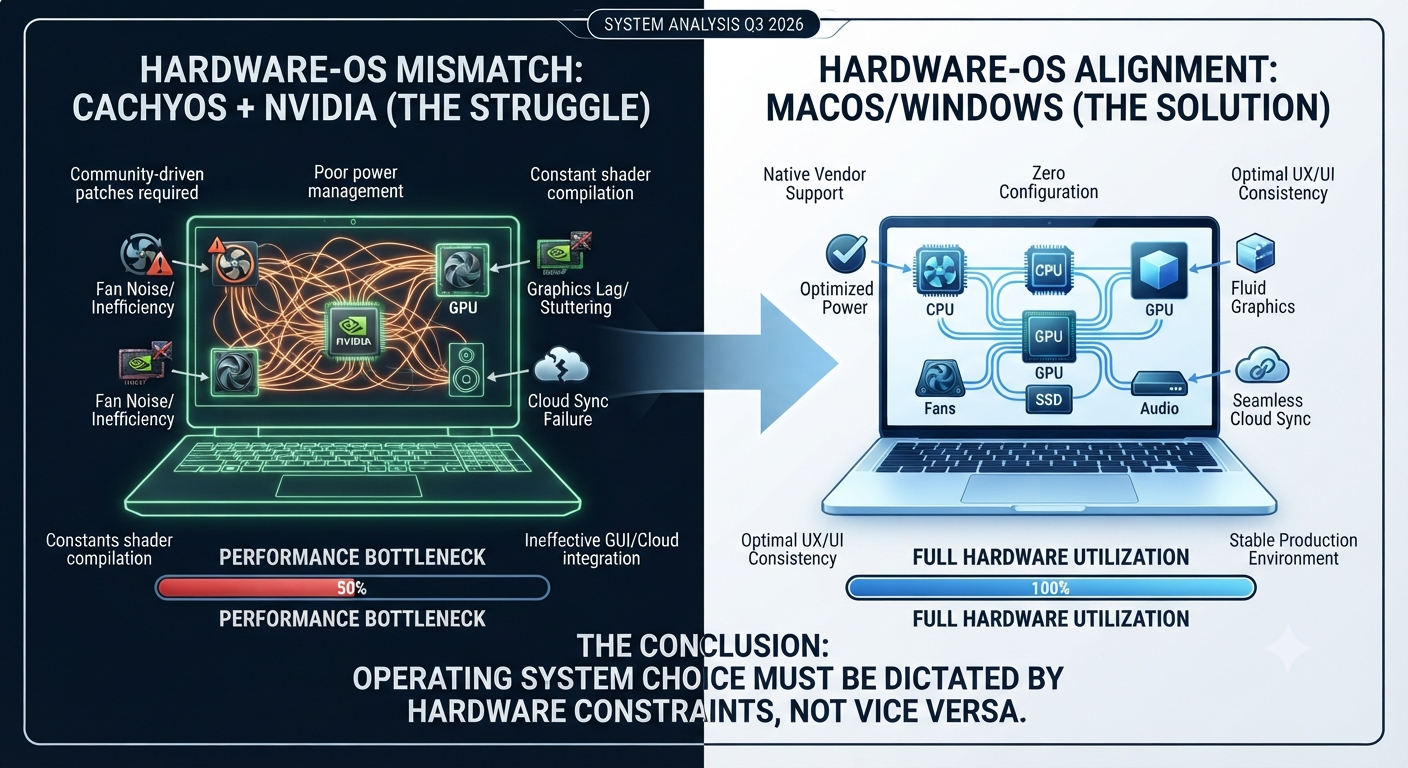
Over the past few months I conducted a deep immersion into the Linux ecosystem—specifically utilizing CachyOS, dynamic tiling window managers like Niri/iNIR, and high-performance hardware powered by an NVIDIA GPU inside a (gaming) laptop.
The outcome of this experience confirms an unavoidable technical reality for professional and high-demand profiles: the operating system must be chosen based on the available hardware, not the other way around. Forcing closed architectures or proprietary components into environments they weren’t natively designed for severely penalizes productivity, workflow management, and the overall user experience.
Key Challenges Encountered in #Linux Environments with NVIDIA Hardware
Power Management and Proprietary Hardware: In a gaming laptop, component synergy is critical. With performance-focused distributions like #CachyOS, native management of fans, power profiles, lighting, and speakers is frequently relegated to community-driven patches. The operational result included poor thermal performance, acoustic degradation under heavy loads, and a noticeable drop in GPU capabilities.
The Graphics Bottleneck in Gaming (Proton/Vulkan): While tools like Proton allow for running Steam libraries, the operational cost is high. Constant shader compilation processes, the lack of seamless integration with NVIDIA’s proprietary drivers, and instability in technologies like DLSS or Ray Tracing may turn the gaming experience into a fragile and poorly optimized process for medium-to-high-end hardware.
Productivity and Cloud Synchronization: For advanced workflows, reliance on cloud ecosystems (Google Drive, OneDrive, iCloud) and file managers with native, transparent NTFS support is critical. File managers in alternative environments suffered from rendering shortcomings, manual permission management (chmod/fstab), and deficient integration with standard office applications.
User Experience (UX/UI) and Window Ecosystems: Dynamic tiling window managers offer a very appealing minimalist aesthetic on paper, but they lack the ergonomic maturity needed for configuration menus, display management, or stable visual transitions compared to mainstream desktop environments.
Forcing the adoption of #Linux on constrained and highly proprietary hardware—such as a modern laptop with an #NVIDIA GPU—creates an interesting technical sandbox for academic or systems learning purposes, but it is unviable for demanding production, multimedia, and entertainment use cases.
Hardware Sets the Standard: Investing in high-performance gaming hardware requires operating systems capable of leveraging 100% of their proprietary drivers without friction.
The Real Alternative? For profiles that prioritize fluidity, cloud integration, and absolute hardware performance without configuration friction, the only consistent market choices remain Windows or macOS.
Deja una respuesta